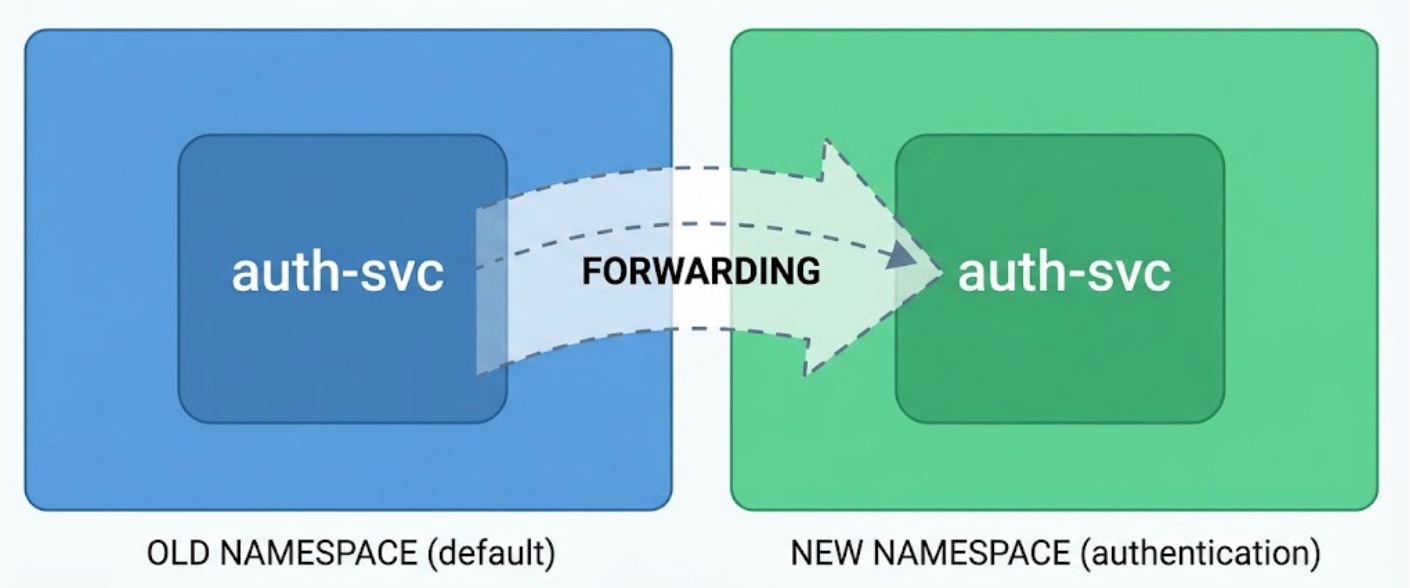
Moving a Kubernetes service to another namespace without downtime
CNCF published a nice write-up by George Sims: Migrating a critical Kubernetes deployment from the default namespace without any downtime. The story is about an auth service that lived in default for years, but the approach works for moving any service from one namespace to another. default is just the example. The main idea is simple. You keep the old DNS name alive as a compatibility point. In the old namespace you leave a Service of type ExternalName that points to the service in its new namespace, and callers keep working without changing anything....
Claude Code cloud sessions are out of preview, with a $100 / $250 credit to try them
Anthropic announced today that Claude Code cloud sessions are generally available and no longer a research preview. The one-line pitch: Claude Code keeps working even when your laptop is closed. To get people to try it, existing Pro and Max subscribers get a one-time credit: $100 on Pro, $250 on Max. What a cloud session is A normal Claude Code session runs on your machine. If the laptop goes to sleep, loses Wi-Fi, or you just close the lid to go home, the session stops with it....
Claude Opus 5.5: faster, cheaper, and better at long agentic work
Anthropic released Claude Opus 5.5 today. It’s the new flagship, and the pitch is simple: it beats Opus 5 on most things while costing less and responding faster. Usually you only get one of those at a time. What actually changed The biggest gains are in agentic coding, computer use, and general knowledge work. Anthropic also says the model holds up better on long-running tasks and large codebases, which is where earlier models tended to lose track of what they were doing a few hours in....
SkillsMP: an Agent Skills marketplace for Claude Code and Codex
SkillsMP is a searchable catalog of Agent Skills for Claude Code and Codex SkillsMP indexes Agent Skills pulled from public GitHub repositories and puts them behind a search box, a category browser, and per-skill cards that link back to the source repo Its own FAQ says it has collected 200,000+ skills so far (marketing copy elsewhere on the site claims over 2 million, so treat exact counts loosely). Categories run from backend, machine-learning, and llm-ai to security, devops, and web3-tools — around 70 in total, plus browsing by occupation and a timeline view...
Agent Plugins: one folder for skills and MCP servers, minus Claude
If you’ve built an Agent Skill and wired it to an MCP server, you already know the annoying part isn’t the skill. It’s everything around it. The instructions travel fine as a markdown file. The MCP server config does not, because every client wants its own directory layout, its own manifest, its own way of saying “run this process and pass it these environment variables.” Vercel, AWS, GitHub, Microsoft, OpenAI, and the Cursor team shipped Agent Plugins 1....
GitHub Spec Kit: give the AI agent a spec, not a vibe
Ask Claude, Codex, or Gemini to “build me an ERP with auth, billing, a dashboard, and a mobile app” and you’ll get something that half works and is architecturally cursed in ways you won’t notice until week three. The model isn’t bad at writing code. It’s bad at simultaneously inventing the product, the architecture, and the implementation order while also writing the code. GitHub’s Spec Kit exists to split those apart....
Kubernetes 1.37 (Garhwal): what's worth knowing
Kubernetes 1.37, codename Garhwal, shipped August 26, 2026 after a 15-week cycle. 67 enhancements: 16 graduating to Stable, 23 to Beta, 27 new in Alpha, one deprecation track. Full release notes here. The API surface itself tells a tighter story than the enhancement count does. I traced the actual version history of every API resource that changed in 1.37, back to 1.34, instead of trusting a changelog summary: .kv-wrap{margin:1.5rem 0;border:1px solid #e3e3e6;border-radius:10px;padding:2px;overflow-x:auto} ....
Kyverno threat model: the defaults that make enforcement optional
Fail open, by default Audit mode is not enforcement PolicyException: the quiet bypass Kyverno doesn’t watch its own namespace What Kyverno can never protect Sign and verify, not either Turning the admission controller into an SSRF probe Summary Kyverno released a threat model and hardening guide in April 2026, produced by the security consultancy ControlPlane in partnership with the CNCF and reviewed by Kyverno’s own maintainers (Jim Bugwadia and Shuting Zhao among them)....
Terraform to OpenTofu: is it worth migrating?
A reader sent me a question I’ve been getting more often lately: they’re running Terraform 1.5, S3 backend, no Terraform Cloud, no HCP. Is it worth moving to OpenTofu? Short answer: probably yes, and this setup happens to be close to the easiest case there is. Here’s why. The fork point matters OpenTofu forked from Terraform 1.5.x, the last version released under the MPL license before HashiCorp switched to BSL. So if you’re still on 1....

Kubernetes tools
This list is being updated on regular basis General info https://kubernetesreadme.com/ UI / Desktop Clients K9s — terminal UI for navigating clusters, resources, events, logs, and metrics https://k9scli.io/ Freelens — free and open-source IDE for Kubernetes (community fork of Lens, no account required) https://github.com/freelensapp/freelens Lens — full-featured Kubernetes desktop IDE with workload, metrics, and troubleshooting views https://k8slens.dev/ Headlamp — web-based Kubernetes UI, good for remote admin https://headlamp.dev/ Kubevious — maps cluster relationships and highlights configuration issues visually https://kubevious....